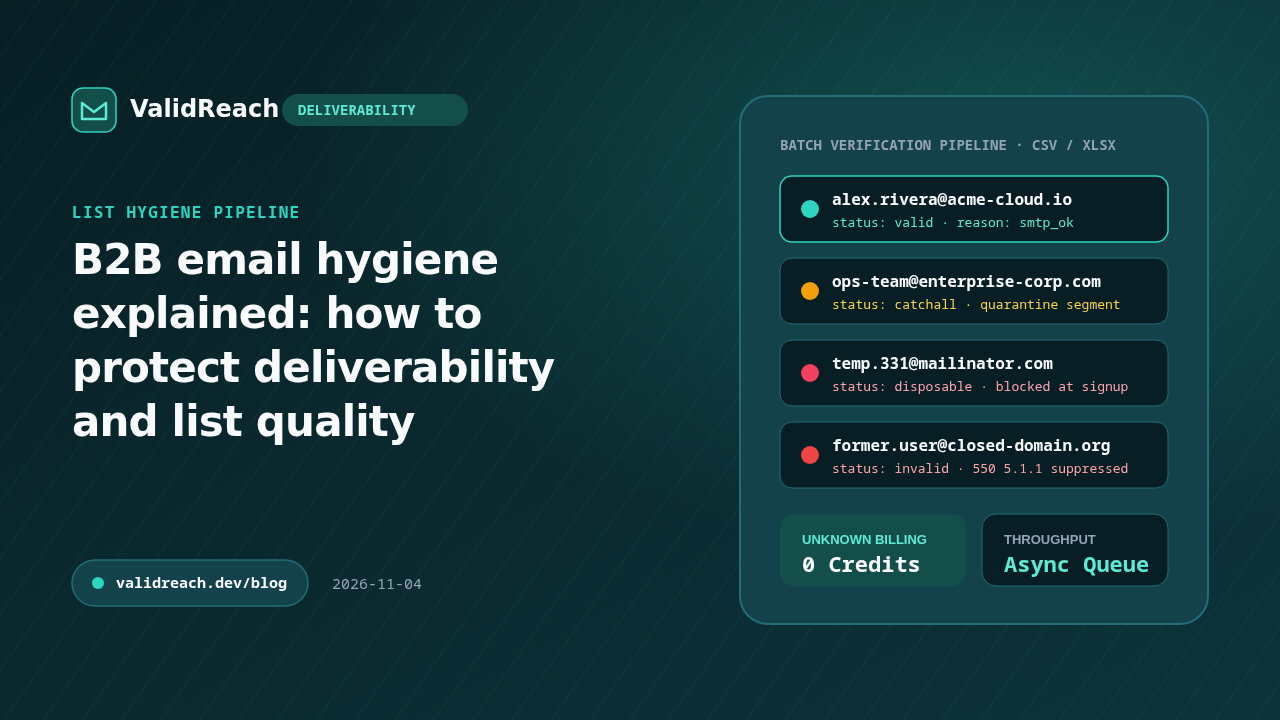
B2B email lists age faster than consumer lists because work addresses are tied to employment, company domains and corporate IT policies. When a contact changes jobs, merges companies or leaves a role, a previously valid work address turns into a hard bounce or an unmonitored forwarding inbox.
Why B2B lists require continuous hygiene
As outlined in M3AAWG's Sender Best Common Practices and Google's Email Sender Guidelines, mailbox providers judge senders by bounce rates, spam complaints and recipient engagement. A B2B list that was verified six months ago can accumulate deactivated employee mailboxes, expired domains and role-account reassignments that trigger bounces on the next quarterly announcement.
The four stages of B2B email hygiene
- Point-of-capture check: validate syntax, domain MX records, disposable domains and mailbox status when a lead submits a form or enters your CRM.
- Pre-campaign batch refresh: re-verify segments that have not been mailed recently before launching an event invite or product update.
- Policy routing by status: route
validcontacts to your main sequence, holdcatchallandroleaddresses for smaller throttled sends, and immediately suppressinvalidanddisposableresults. - Automated bounce and sunset suppression: remove hard bounces after the first permanent
5xxfailure and retire contacts who never engage after a re-confirmation check.
Sources
- M3AAWG — Sender Best Common Practices — accessed 2026-11-04
- Google Workspace Admin Help — Email sender guidelines — accessed 2026-11-04