Marketing pages often claim near-perfect accuracy without disclosing the test sample or date. ValidReach publishes no unverifiable claims about ZeroBounce; instead, this guide explains ValidReach's exact production contracts and gives you a repeatable test plan to compare both services on your own list.
1. Compare core verification vs. add-on features
ValidReach focuses on deterministic email verification, batch list cleaning and free DNS/deliverability diagnostics (SPF, DKIM, DMARC, DNSBL):
- Every address is evaluated across syntax (RFC 5321 / RFC 5322), DNS/MX resolution, disposable domain detection, role-account classification, catch-all probing and mailbox verification.
- Decide whether your stack needs a focused, low-latency verification API and batch pipeline or bundled third-party enrichment add-ons, and compare total credit consumption per verified address.
2. Check billing for unknown results and credit policies
- ValidReach billing contract:
valid,invalid,risky,disposable,catchallandrolecost 1 credit per check;unknownresults cost0credits. Pay-as-you-go credits do not expire, and optional monthly plans are available on/pricing. - How to compare: review ZeroBounce's current documentation to check how
unknown/do_not_mailsub-statuses are billed and how credits roll over.
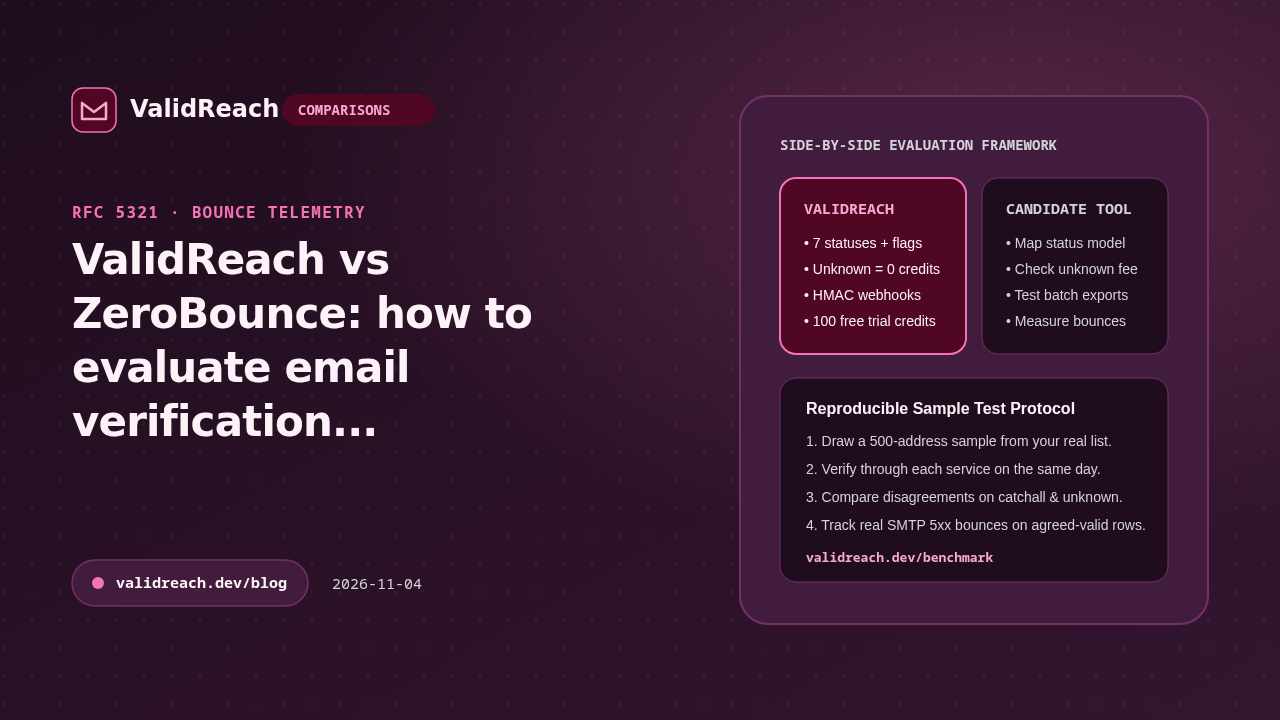
3. Run the side-by-side evaluation on your own sample
- Export a 500-address stratified sample from your real signup or CRM list.
- Run the identical file through ValidReach and ZeroBounce within the same hour.
- Compare where the two tools agree and where they differ (especially on
catchallandunknownrows), then measure actual SMTP bounce codes on a small controlled send.
Sources
- ValidReach Verification Results Reference — accessed 2026-11-04
- ValidReach Benchmark & Evaluation Methodology — accessed 2026-11-04
- IETF RFC 5321 — Simple Mail Transfer Protocol — accessed 2026-11-04